For small startups, every dollar and every second counts. You can’t afford server downtime or unpredictable costs — yet you need a setup powerful enough to grow fast when your idea starts gaining traction. That’s where a cloud hosting provider for small startup with hourly billing comes into play. Instead of paying a flat monthly or annual fee, hourly billing lets you pay only for what you actually use.
In 2025, this flexibility has become a game changer. From launching an MVP to scaling after your first funding round, startups now rely on cloud solutions that are agile, cost-efficient, and designed to handle unpredictable growth. Whether you’re a solo founder testing a new SaaS or a small team building a mobile app, hourly-billed cloud hosting ensures you scale smart — not expensively.
TL;DR – Cloud Hosting Provider for Small Startup (Hourly Billing)
Pay-as-you-go pricing keeps costs aligned with usage.
Instant scalability supports sudden traffic spikes.
Global data centers improve performance for international users.
Hourly billing options give startups tighter control over expenses.
Top picks: AWS, DigitalOcean, Kamatera, and Vultr lead in flexible hourly pricing for startups.
In short, the right cloud hosting provider for small startup with hourly billing helps you save money early, then scale effortlessly when your user base grows.
Quick Overview – Comparison of Cloud Hosting for Startups
Modern startups need more than just storage and uptime — they need speed, flexibility, and transparent billing. Here’s how a Cloud Hosting Provider for Small Startup stands apart from traditional web hosting:
| Feature | Traditional Hosting | Cloud Hosting (Hourly Billing) |
|---|---|---|
| Pricing Model | Fixed monthly/yearly | Pay per hour or per usage |
| Scalability | Limited | Instant, auto-scale |
| Performance | Shared resources | Dedicated virtual resources |
| Reliability | Server downtime risk | 99.9% uptime with redundancy |
| Best For | Static websites | Startups, SaaS, and fast-scaling apps |
Unlike typical hosting, cloud hosting providers for small startup with hourly billing offer complete flexibility — you can start with the lowest tier and scale up instantly. No lock-in, no wasted resources, and no guessing what your traffic might be next month.
This freedom lets startup founders focus on innovation, not infrastructure. The upcoming sections will dive deeper into what cloud hosting means for startups, why it matters, and how to choose the best one for your growth journey.
What Is Cloud Hosting and What Does It Mean for Startups?
At its core, cloud hosting means your website or app doesn’t live on one single server — it lives in a distributed network of virtual servers. Instead of relying on a single point of failure, your data and applications are hosted on multiple servers across regions. This setup offers higher uptime, faster performance, and better reliability — three things startups can’t compromise on.
For a small startup, the concept of “cloud” isn’t just about servers — it’s about freedom. You don’t need to buy expensive hardware or maintain physical infrastructure. You rent computing power, storage, and bandwidth from a cloud hosting provider for small startup with hourly billing, paying only for what you actually use.
Think of it like electricity: you don’t pay for a full day’s power if you only run the lights for four hours. The same principle applies here — startups can build, test, and deploy without the financial burden of long-term commitments.
Why Cloud Hosting Matters for Startups
The early stage of a startup is unpredictable — traffic fluctuates, product updates happen weekly, and user growth can spike overnight. That’s why cloud hosting isn’t a luxury; it’s a necessity.
Here’s why it’s crucial:
Cost control: Hourly billing prevents unnecessary spending, making it perfect for lean operations.
Scalability: You can scale up or down instantly depending on demand.
Global reach: With data centers across continents, your users experience faster load times no matter where they are.
Security: Startups handle customer data from day one. Reputed cloud hosting providers for small startup with hourly billing offer SSL, firewalls, and DDoS protection by default.
Agility: You can launch, test, and iterate without infrastructure headaches — essential for staying ahead of competitors.
In short, cloud hosting gives startups the same power that global tech giants use, but at a fraction of the cost — and without needing a full-time IT department.
7 Key Benefits of Cloud Hosting for Startups
1. Lower Costs with a Cloud Hosting Provider for Small Startup (Pay-as-You-Grow Pricing)
Traditional hosting forces you into a fixed monthly fee — whether you use the resources or not. In contrast, a cloud hosting provider for small startup with hourly billing charges only for what’s consumed. That means if your app only runs tests for six hours a day, you’re only billed for those hours. This pay-as-you-grow model keeps cash flow lean, perfect for early-stage founders watching every cent.
2. Faster Launches and Shorter Time-to-Market
Startups thrive on speed. Cloud platforms let you deploy servers in minutes, not days. With pre-configured stacks and one-click app deployment, you can launch your MVP over a weekend instead of waiting for IT support. This speed helps startups iterate quickly and get real user feedback faster.
3. Effortless Scalability as You Grow
When your product gains traction, you don’t have to rebuild infrastructure. You can scale memory, CPU, or bandwidth instantly — even automate it. The elasticity of cloud hosting makes it ideal for unpredictable growth phases where traditional servers would crash under pressure.
4. Remote Collaboration Made Easy
Startups today are remote-first. Cloud hosting enables teams to collaborate seamlessly from anywhere. Developers, marketers, and designers can all access the same platform, view analytics, and deploy updates in real time — no VPNs or local servers required.
5. Built-in Security and Data Protection
Security breaches can kill trust instantly. Leading cloud hosting providers for small startup with hourly billing offer enterprise-grade protection: firewalls, data encryption, automated backups, and multi-factor authentication. You get security that rivals large corporations without paying enterprise prices.
6. Business Continuity and Disaster Recovery
Accidents happen — servers crash, code breaks, or data gets corrupted. Cloud hosting’s redundant architecture ensures your startup never goes offline. With automatic backups and real-time failover, you can restore services in minutes, not hours.
7. Access to Cutting-Edge Innovation
Startups using cloud hosting get access to advanced tech — AI APIs, machine learning tools, CDN integration, and managed databases. Instead of hiring specialists, you can plug into ready-made cloud solutions that accelerate your innovation pipeline.
15 Best Cloud Hosting Providers for Startups in 2025
The cloud hosting landscape is evolving faster than ever. Startups in 2025 have dozens of options, but not all providers are built equally — especially when you’re looking for hourly billing, transparent pricing, and developer-friendly tools. Below are the 15 best cloud hosting providers for small startup with hourly billing, ranked for performance, scalability, support, and cost efficiency.
1. Bluehost
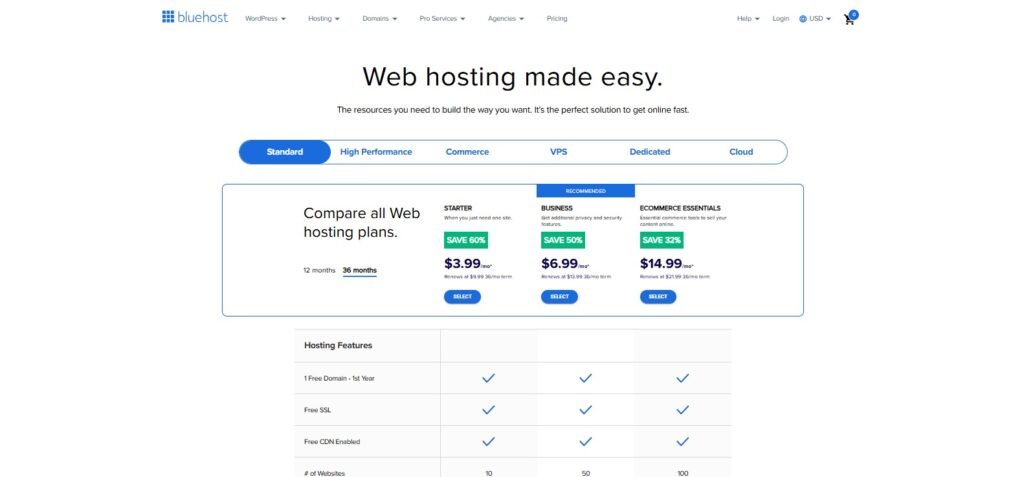
Bluehost has expanded far beyond traditional web hosting. Their cloud hosting plans for startups include on-demand scalability, free SSL, and hourly billing flexibility through integrated cloud partners.
Best for: Early-stage startups launching WordPress or SaaS prototypes.
Highlights: Auto-scaling, daily backups, 24/7 support, and built-in caching.
2. HostGator
A reliable name in budget-friendly hosting, HostGator now provides hybrid cloud hosting solutions ideal for new startups. With intuitive dashboards and instant scaling, founders can start small and grow gradually.
Best for: Bootstrapped startups testing early MVPs.
Highlights: Hourly resource tracking, fast SSD storage, and free domain for one year.
3. AWS (Amazon Web Services)
AWS remains the go-to cloud hosting provider for small startup with hourly billing. With services like EC2 and Lightsail, you pay only for instance hours used. Their free tier lets you experiment for months without cost.
Best for: Tech-driven startups expecting high growth.
Highlights: Global infrastructure, 99.99% uptime, AI integration, and robust documentation.
4. Microsoft Azure
Azure’s developer-first ecosystem is perfect for startups that rely on Microsoft tools. You can deploy scalable apps, use AI APIs, and integrate CI/CD pipelines easily.
Best for: SaaS startups built on .NET or Windows frameworks.
Highlights: Hourly pricing, enterprise-grade security, and 12-month free tier.
5. Google Cloud Platform (GCP)
Google Cloud is ideal for startups that prioritize data analytics, speed, and performance. Its per-second billing model makes it even more flexible than most hourly providers.
Best for: Startups working with big data or machine learning.
Highlights: Lightning-fast global network, serverless options, and generous startup credits.
6. IBM Cloud
IBM Cloud combines high-performance virtual machines with AI-driven analytics. It’s great for startups in fintech or data-heavy industries.
Best for: Startups focusing on analytics or blockchain.
Highlights: Hourly pricing, top-tier encryption, and hybrid deployment options.
7. DigitalOcean
A favorite among developers, DigitalOcean offers simple pricing and hourly billing that’s truly transparent. With its “droplets,” startups can launch in seconds.
Best for: Developer-led startups and small tech teams.
Highlights: Predictable billing, global data centers, and active developer community.
8. Oracle Cloud
Oracle Cloud’s Always Free Tier gives startups generous compute power at zero cost. Its performance and reliability make it competitive with AWS and Azure.
Best for: Data-intensive startups or enterprise SaaS builders.
Highlights: Hourly pricing, strong SLAs, and advanced database optimization.
9. Cloudflare
While known for CDN and DDoS protection, Cloudflare now offers edge-based cloud hosting services with pay-as-you-go pricing.
Best for: Startups needing global speed and website security.
Highlights: Hourly compute credits, built-in caching, and edge deployment.
10. Kamatera
Kamatera is one of the most flexible cloud hosting providers for small startup with hourly billing, allowing startups to spin up custom servers in under a minute.
Best for: Founders who want full control over configurations.
Highlights: True hourly billing, instant scaling, and excellent support.
11. Vultr
Vultr’s hourly and monthly plans make it perfect for startups experimenting with prototypes. Their new high-performance cloud instances deliver impressive speed.
Best for: Fast deployment and cost-sensitive scaling.
Highlights: Hourly pricing, global data centers, and SSD-based infrastructure.
12. Heroku
Heroku simplifies development with its fully managed platform-as-a-service (PaaS) model. Perfect for developers who want to focus on code, not servers.
Best for: App developers and SaaS MVPs.
Highlights: Hourly dyno pricing, one-click deployment, and easy GitHub integration.
13. Rackspace
Rackspace offers managed cloud services with a focus on support. Startups get 24/7 monitoring and flexible hourly or monthly billing options.
Best for: Startups that want “hands-off” hosting with premium support.
Highlights: Hybrid cloud options, hourly compute, and managed scaling.
14. SiteGround
SiteGround combines simplicity with advanced cloud tools. Their infrastructure is Google Cloud-backed, meaning startups get enterprise-grade performance with hourly-level flexibility.
Best for: Agencies or small SaaS teams needing performance + simplicity.
Highlights: Free CDN, backups, and on-demand scalability.
15. IONOS
IONOS focuses on affordable cloud infrastructure for small businesses and startups. Their pay-per-use model ensures you only pay for what’s active.
Best for: Small teams and local startups.
Highlights: Hourly billing, real-time monitoring, and free SSL certificates.
Real Startups That Scaled Successfully with Cloud Hosting
The best proof of the power of cloud hosting isn’t marketing — it’s success stories. Some of today’s most valuable startups began as small, scrappy teams using flexible cloud hosting providers for small startup with hourly billing to minimize costs and scale fast. Let’s explore how companies like Slack, Airbnb, Dropbox, and Notion grew from small beginnings to global dominance — powered by the cloud.
1. Slack — Scaling Communication Effortlessly
Slack began as a small internal tool for a gaming company. When they pivoted into team communication, they needed infrastructure that could handle exponential growth without crashing.
By using Amazon Web Services (AWS) — one of the best cloud hosting providers for small startup with hourly billing — Slack was able to launch globally without owning physical servers.
Challenge: Rapid scaling, unpredictable user growth.
Cloud Solution: AWS EC2 and S3 for flexible, hourly resource allocation.
Result: Slack could handle millions of daily messages while maintaining 99.99% uptime.
The key lesson? Build infrastructure that grows faster than your user base.
2. Airbnb — From Spare Rooms to a Global Empire
Airbnb’s early days were fueled by experimentation and tight budgets. Instead of investing in data centers, the founders used Amazon Web Services to deploy updates quickly, manage traffic surges, and roll out features globally.
Challenge: Managing unpredictable traffic spikes during big events.
Cloud Solution: Elastic compute and storage on-demand.
Result: Scaled from hundreds to millions of listings with minimal downtime.
Airbnb proved that startups with strong product-market fit should prioritize scalable infrastructure over costly hardware — and cloud hosting delivers that flexibility instantly.
3. Dropbox — Building Trust Through Reliability
Dropbox’s core product — secure file storage — demands flawless uptime and data protection. Initially hosted on AWS, Dropbox relied on hourly-billed cloud servers for global data access.
Challenge: Delivering speed and reliability to millions of users.
Cloud Solution: Multi-region data replication and scalable bandwidth.
Result: Dropbox maintained near-instant file sync even during explosive growth.
For early founders, Dropbox’s success shows how cloud redundancy safeguards both user experience and brand trust — something every cloud hosting provider for small startup with hourly billing now emphasizes.
4. Notion — Cloud-Native Collaboration at Scale
Notion’s rise to fame as a workspace super-app was powered entirely by the cloud. Its lean engineering team built on scalable cloud infrastructure that could handle millions of real-time edits without lag.
Challenge: Real-time collaboration for a growing global user base.
Cloud Solution: Dynamic load balancing and elastic resource allocation.
Result: Seamless, low-latency performance across continents.
Notion’s journey proves that cloud-native startups can achieve enterprise-level performance without enterprise budgets.
Lessons from These Startups
Flexibility wins: Each company used cloud hosting to pivot, experiment, and expand fast.
Pay for what you use: Hourly billing kept their costs proportional to growth.
Focus on product, not infrastructure: The cloud handled scaling so founders could focus on innovation.
Reliability = trust: Consistent uptime built user confidence, fueling organic growth.
Start small, scale smart: The cloud made it possible to test, fail, and relaunch without major losses.
In short, the most successful startups didn’t grow despite using cloud hosting — they grew because of it. Choosing the right cloud hosting provider for small startup with hourly billing is more than a technical decision; it’s a business growth strategy.
How to Choose the Best Cloud for Your Startup
Finding the right cloud hosting provider for small startup with hourly billing can feel overwhelming — dozens of options, endless features, and pricing that’s sometimes confusing. But if you strip it down to what actually matters for a lean startup, your decision should hinge on these six key factors:
Pricing Flexibility
Look for true hourly billing or per-second billing so you’re not overpaying. For early MVPs that run part-time, this can save up to 60% in unnecessary costs.Scalability
The provider should let you scale CPU, RAM, or storage instantly. Avoid hosts that require manual plan upgrades — your growth shouldn’t wait for customer support tickets.Performance
Check data center proximity, SSD storage, and CDN availability. Startups building global products benefit from distributed hosting that minimizes latency.Security
Built-in SSL, DDoS protection, and automatic backups are non-negotiable. You want startup agility, not startup risk.Ease of Use
Choose platforms with intuitive dashboards, one-click app deployment, and developer APIs — so your team can focus on building, not babysitting servers.Support & Documentation
Startups move fast. Your host’s support should, too. 24/7 live chat or ticket-based assistance ensures you’re not stuck when every minute counts.
In short, the best cloud hosting provider for small startup with hourly billing balances affordability with agility — giving you a setup that grows as fast as your idea does.
Getting Started with Bluehost Cloud Hosting for Startups: Buy New or Migrate Smoothly
If you’re new to the cloud, Bluehost is a beginner-friendly entry point. It offers a guided onboarding process, one-click WordPress setup, and the option to upgrade into fully managed cloud instances as your traffic grows.
For new startups:
Start with a basic cloud plan and connect your domain.
Enable auto-scaling to manage sudden visitor spikes.
Use their integrated performance tools to monitor bandwidth and CPU usage.
For migrations:
Bluehost’s migration assistant transfers your site with zero downtime.
You can test everything in a staging environment before going live.
This hybrid approach — easy entry with upgrade flexibility — is exactly what early-stage startups need before diving into more complex platforms like AWS or Google Cloud.
Your Cloud Hosting Roadmap: From MVP to Scale in 5 Steps
Cloud hosting isn’t just about deployment — it’s a long-term growth system. Below is a 5-step roadmap to go from an MVP idea to a scalable, investor-ready infrastructure.
Step 1. Launch MVP
Start lean. Choose a lightweight plan from your chosen cloud hosting provider for small startup with hourly billing. Focus only on core features. Keep load times under 3 seconds and ensure the site or app is stable under small traffic.
Step 2. Monitor Usage
Use built-in analytics (or tools like New Relic or Datadog) to track traffic, memory, and CPU. This data helps you understand where resources spike and which plan upgrades actually matter.
Step 3. Scale Based on Traffic
As users grow, increase resources gradually. Many providers like Kamatera and DigitalOcean let you automate scaling — no downtime, no manual migration.
Step 4. Optimize Billing and Auto-Scale Settings
Hourly billing gives startups financial agility — but it only works if you monitor usage. Set up auto-scaling rules and use alerts to pause idle resources. This can reduce monthly costs by 20–40%.
Step 5. Prepare for Growth and Demo Day
Before pitching to investors or launching globally, stress-test your infrastructure. Use load-testing tools and simulate high traffic. A stable, cloud-backed MVP builds credibility and investor confidence.
The Future of Cloud Hosting for Startups
The future of cloud hosting is being defined by automation, AI, and unprecedented flexibility. Startups no longer need to guess what kind of infrastructure they’ll need — intelligent systems will adjust in real time based on actual usage, optimizing both cost and performance automatically.
In 2025 and beyond, cloud hosting providers for small startup with hourly billing are expected to evolve in three major ways:
Smarter Auto-Scaling with AI
AI-driven platforms will predict usage spikes before they happen. Instead of reacting to traffic surges, cloud servers will self-optimize — scaling up or down with zero input from developers.Decentralized Cloud & Edge Computing
With the rise of IoT and remote work, startups will shift to distributed cloud systems. This means faster access, lower latency, and better privacy. Providers like Cloudflare and AWS are already leading this transformation.Transparent, Real-Time Billing Models
Hourly billing will become even more granular — per-minute or per-second models will dominate, ensuring startups pay only for actual compute time. This precision empowers small teams to manage budgets like enterprises.
In short, the future belongs to startups that embrace elastic, data-driven hosting. The more adaptive your infrastructure, the faster you can innovate without financial friction.
Final Thoughts
Choosing the right cloud hosting provider for small startup with hourly billing isn’t just a technical decision — it’s a growth decision. Cloud hosting removes the two biggest barriers to startup success: high cost and limited scalability.
When you choose wisely:
You gain enterprise-level performance at startup-level pricing.
You build resilience — no single point of failure, no downtime panic.
You earn agility — the ability to pivot, iterate, and expand without delay.
Whether you pick AWS for global reach, DigitalOcean for simplicity, or Kamatera for custom scaling, remember one rule: start lean, scale smart. The right cloud hosting provider doesn’t just host your startup — it becomes the foundation of your success story.
FAQs
1. What is the cheapest cloud hosting provider for startups with hourly billing?
DigitalOcean, Vultr, and Kamatera offer some of the lowest hourly rates, starting as low as $0.005 per hour depending on configuration.
2. Can I migrate from shared hosting to a cloud platform easily?
Yes. Most modern cloud providers (Bluehost, SiteGround, AWS) offer one-click migration tools with zero downtime for existing websites or apps.
3. Is hourly billing really cheaper than monthly hosting?
For startups, yes. Hourly billing ensures you pay only for actual server time. If your app isn’t running 24/7, this can cut hosting expenses by up to 50%.
4. Which cloud hosting provider is best for developer-driven startups?
DigitalOcean, Vultr, and Heroku are ideal for developer teams due to their clean APIs, fast deployment, and strong community support.
5. How do I know when to scale my cloud resources?
Monitor usage metrics like CPU, bandwidth, and response time. When these consistently hit 70–80% capacity, it’s time to scale up or automate scaling.